

You’re mad. Really mad.
The kind of mad where words are locked and loaded, ready to fire.
He did something that hurt you. Or forgot something important. Or said something thoughtless.
And now you’re both caught in a heated argument, voices raised and emotions running high.
In that moment, it’s tempting to say the first thing that comes to mind, to use the sharpest words possible just to make him feel the hurt he caused.
But here’s the thing about fighting in marriage: some words don’t just sting in the moment.
They leave scars.
The kind that don’t heal even after you’ve apologized and made up.
I’ve been there. Said things in anger that I couldn’t take back. Watched my husband’s face change from angry to hurt to shut down.
And I learned the hard way that winning an argument isn’t worth losing trust and safety in your marriage.
So before you let anger drive your mouth, here are seven things you should never say to your husband during a fight.
No matter how mad you are.
7 Things to Never Say to Your Husband During a Fight
#1: “You Always…” or “You Never…”
” always forget what I tell you.”
” never help around the house.”
” always make everything about you.”
Sound familiar?
When you’re mad, it’s easy to exaggerate. To take one incident and turn it into a character accusation.
But here’s what he hears when you say “always” or “never”: “Nothing I do is ever good enough.”
Even if he helps sometimes, just erased all of it with one sweeping statement.
Why it’s damaging:
It’s rarely true. And even if there’s truth in it, absolutes make people defensive instead of reflective.
He stops hearing your actual complaint and starts defending himself. “That’s not fair! I helped last week!”
Now you’re arguing about whether he “always” or “sometimes” does something instead of addressing the real issue.
What to say instead:
Focus on the specific situation.
“I feel frustrated when you forget things I’ve mentioned” instead of “You never listen.”
“I need more help with housework” instead of “You never do anything.”
Specific complaints can be fixed. Character attacks just create walls.
#2: “I Don’t Care Anymore”

When you’re exhausted from the same argument for the hundredth time, this phrase slips out.
“You know what? I don’t even care anymore.”
Maybe you think it’ll make him realize how serious this is. Or maybe you’re just trying to end the fight because you’re drained.
But those four words? They’re terrifying to hear.
Why it’s damaging:
“I don’t care anymore” sounds like you’re giving up on the marriage.
Not just the argument. The whole relationship.
It plants a seed of fear that you’re checked out. That you’ve stopped fighting for what you have together.
And even if you don’t mean it that way, he doesn’t know that in the heat of the moment.
What to say instead:
Be honest about what you’re actually feeling.
“I’m exhausted from fighting about this.”
“I need a break from this conversation.”
“This is really important to me, and I need you to understand that.”
Say what’s true without threatening the foundation of your marriage.
#3: “Maybe I Married the Wrong Person”
This one is nuclear.
You throw it out when you want to hurt him as much as he’s hurt you.
Or when you’re so frustrated that you momentarily question everything.
But the second those words leave your mouth, something breaks.
Why it’s damaging:
You’re not just attacking his behavior. You’re attacking his place in your life.
You’re telling him that he’s not enough. That you regret choosing him. That you’re looking at the exit door.
Even if you apologize later, he’ll never fully unhear it.
It becomes a wound that reopens every time you fight. “She thinks she married the wrong person. What if she’s right?”
What to say instead:
Express frustration without threatening the relationship.
“I’m really hurt right now.”
“This isn’t the marriage I imagined, and I want us to work on that together.”
“I feel disconnected from you lately.”
You can express disappointment without making him feel disposable.
#4: “You’re Just Like Your Father/Mother”

Using his parents as a weapon? Low blow.
Especially if you know he already struggles with being like them in ways he doesn’t like.
You say it because you know it’ll cut deep. And it does.
Why it’s damaging:
Most people have complicated relationships with their parents.
When you compare him to his dad or mom (especially negatively), you’re hitting a nerve that goes way beyond your marriage.
It’s personal. It’s about his identity, his fears, his insecurities.
And now the fight isn’t just about what happened between you two—it’s about his entire upbringing and family dynamics.
What to say instead:
Address the behavior, not the person.
“When you raise your voice like that, it makes me shut down.”
“I need you to listen to me without interrupting.”
Keep the focus on what’s happening between you, not dragging his family into it.
#5: “Whatever.”
One word. Eye roll. Turn away.
Dismissive. Cold. Conversation over.
“Whatever” is what you say when you want to shut him down without actually resolving anything.
Why it’s damaging:
It’s the ultimate sign of disrespect.
You’re telling him his feelings don’t matter. That the conversation doesn’t matter. That he doesn’t matter.
It says “I’m done listening to you” without giving him a chance to be heard.
And it leaves the issue unresolved, which means it’ll pop back up later—probably even worse.
What to say instead:
If you need space, say so clearly.
“I need to step away and cool down before we continue this.”
“Can we talk about this later when we’re both calmer?”
Taking a break is healthy. Dismissing him isn’t.
#6: “Calm Down.”
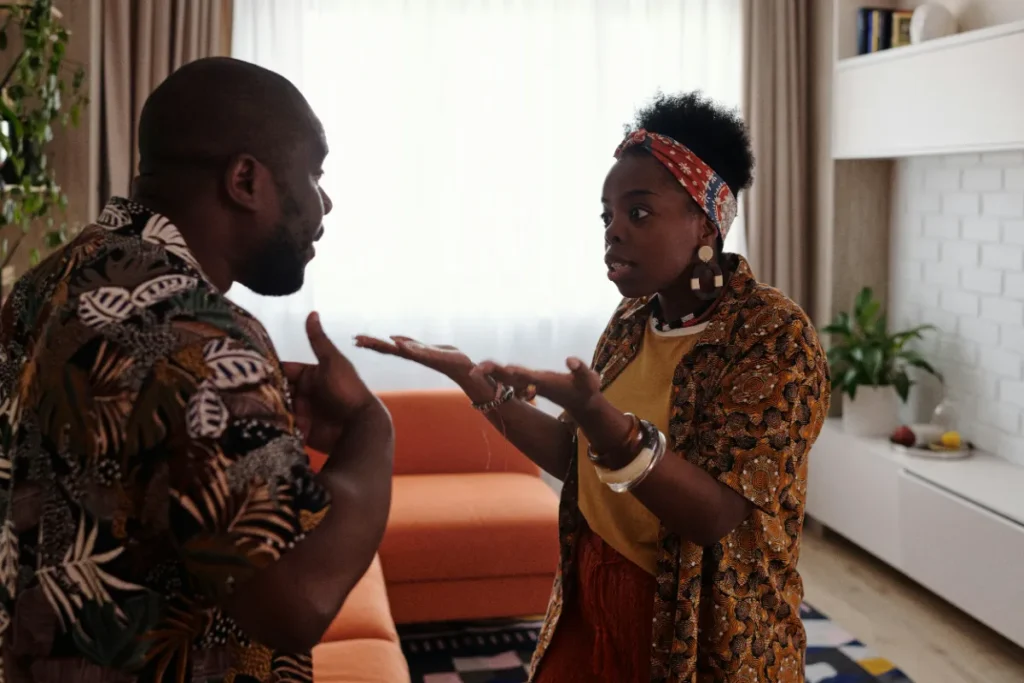
He’s upset. Voice raised, emotions running high.
And you, thinking you’re being the rational one, tell him to “calm down.”
Spoiler: it never works.
Why it’s damaging:
Telling someone to calm down when they’re upset is like throwing gasoline on a fire.
It’s invalidating. It says “Your feelings are wrong” or “You’re overreacting.”
Even if you think he is overreacting, saying this will only make things worse.
Now he’s mad about the original issue and mad that you’re dismissing his emotions.
What to say instead:
Acknowledge what he’s feeling first.
“I can see you’re really upset.”
“I hear that this is important to you.”
“Let’s take a breath together and talk this through.”
Validation calms people down way faster than being told to calm down.
#7: “I Want a Divorce.”

The ultimate threat.
The nuclear option you drop when you want to make him understand how serious things are.
But once you say it, you can’t unsay it.
Why it’s damaging:
Even if you don’t mean it, he’ll wonder if you do.
Every future fight will have that threat hanging in the background. “Is this the one where she actually leaves?”
It destroys the sense of safety in your marriage.
Marriage should be a place where you can fight and disagree without fearing the relationship will end.
When you threaten divorce, you’re telling him that the relationship is always on shaky ground.
What to say instead:
If you’re genuinely unhappy and considering divorce, have that conversation outside of a heated argument. With intention. Possibly with a counselor.
If you’re just angry and overwhelmed, say what’s really going on.
“I feel so disconnected from you right now.”
“I’m scared about where we’re heading.”
“We need help. Can we talk to someone?”
Express the depth of your concern without threatening to blow up the marriage.
Based on Experience
I’m not writing this from some high horse pretending I’ve never said these things.
I have.
In moments of anger, exhaustion, and frustration, I’ve let words fly that I immediately regretted.
I’ve watched my husband’s face go from defensive to hurt. Seen him shut down. Felt the distance grow between us.
And I’ve learned that fights aren’t about winning. They’re about understanding each other and finding solutions.
Some words are weapons. And once you use them, the damage lingers long after the fight ends.
Your husband isn’t your enemy. Even when you’re mad at him.
He’s your partner. The person you chose. The one you promised to love even when it’s hard.
So fight fair. Say what you mean without destroying what you’ve built.
Address the issue without attacking his character.
Express your hurt without using words designed to wound.
At the end of the day, the goal is to solve the problem, not create new ones that are even harder to fix.
Choose your words carefully. They have more power than you think.